
Use-by date labelling in kitchens: a guide to going digital
One hard-to-read date, an unidentified open product or a miscalculated secondary use-by date is enough to disrupt a cold room. Here is how digital use-by date labelling makes the team’s work more reliable without slowing service.
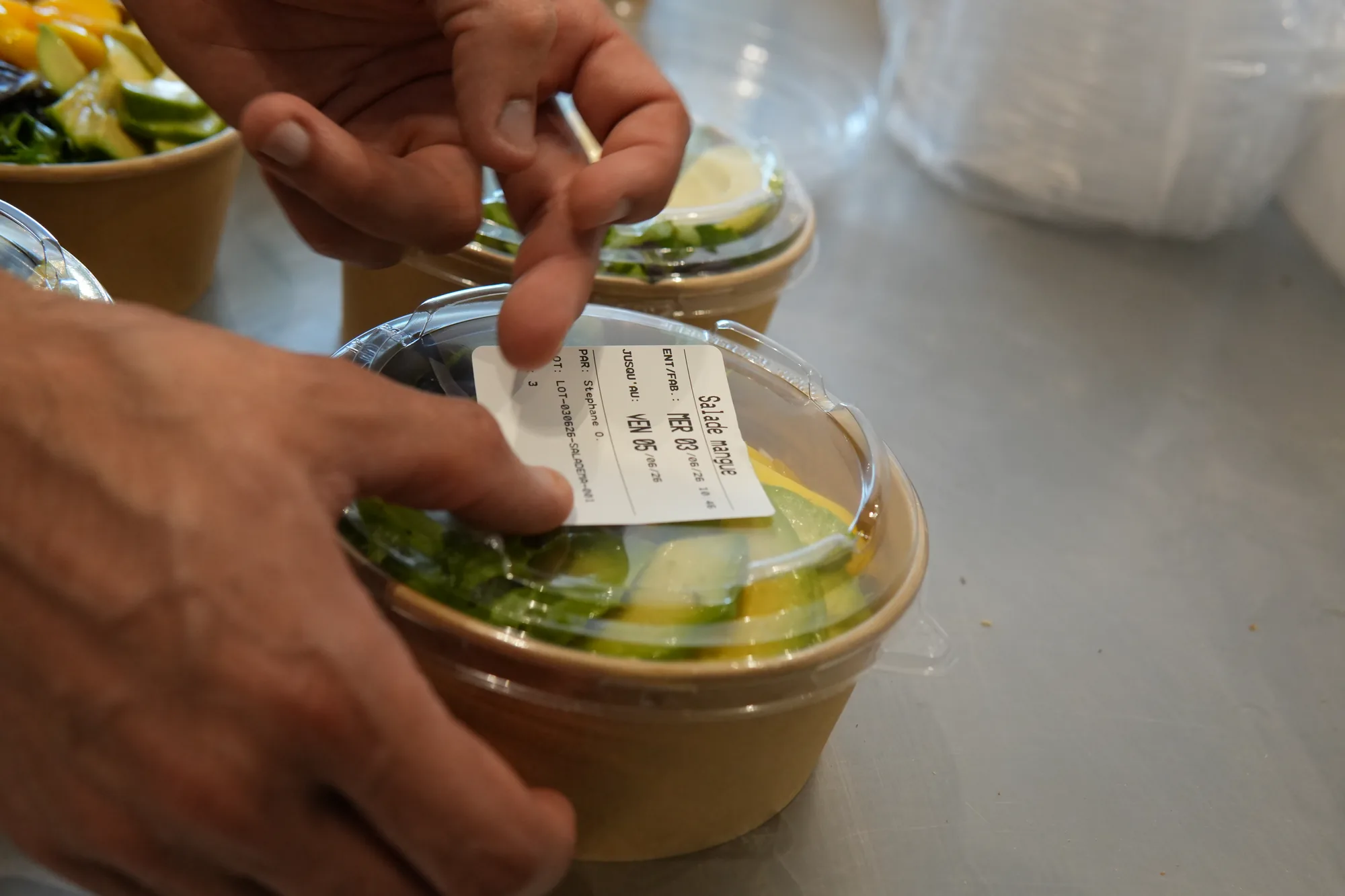
A container sits at the back of the cold room. The lid has a date written in marker: 12/07 or 17/07? Nobody is quite sure, so the product ends up in the bin. In a professional kitchen, this kind of uncertainty costs money and weakens traceability.
Digital use-by date labelling addresses a very practical problem: identifying every product quickly with clear, consistent information, even when several people take turns in production. The aim is not to add another screen to the kitchen. It is to replace mental arithmetic, illegible writing and incomplete labels with a simple procedure the whole team can follow.
With a HACCP application connected to a thermal printer, the product, batch, opening or preparation date and final date can appear in the same format on every print. The result is less hesitation at the fridge, clearer stock rotation and information that is easier to retrieve during an inspection.
Use-by, best-before and secondary use-by dates: three different concepts
Before discussing printers or applications, you need to know which date belongs on the product.
Use-by date: a safety limit
The use-by date applies to microbiologically highly perishable food. It is introduced by the words “use by”. Prepacked food may no longer be sold once this date has passed.
The food business is responsible for setting the use-by date based on evidence that supports the product’s shelf life. An application can automate the calculation from an approved rule; it cannot decide by itself whether a preparation remains safe for two, three or five days.
Best-before date: a quality indication
The date of minimum durability, commonly called the best-before date, is introduced by “best before”. Once it has passed, the product is not automatically unsafe, but it may lose flavour, texture or nutritional quality.
This distinction matters in a kitchen. Confusing best-before and use-by dates can either keep a product that should be discarded or waste food that is still usable.
Secondary use-by date: the date applied after opening or processing
When packaging is opened, a product is removed from its original pack or a preparation is made on site, its usable life may change. This is commonly called a secondary use-by date.
It must take account of the manufacturer’s instructions, the product, preparation conditions, packaging, storage temperature and procedures in the food safety management plan. The manufacturer’s original date remains a limit that must not be exceeded.
For example, if cream is opened today and your procedure allows it to be used for three days, the label should show the opening date and the new final date for use. If the manufacturer’s use-by date comes first, that earlier date takes precedence.
What should a kitchen use-by label contain?
For internal monitoring, a label must first let the team identify the product and immediately understand its status. Depending on the activity and the establishment’s procedures, it will generally include:
- the product or preparation name;
- the date and, where necessary, time of opening or production;
- the final date for use set by the establishment;
- the batch number or a traceability reference;
- storage conditions;
- the quantity produced;
- the identity or initials of the person who performed the operation;
- allergens where these must be monitored or communicated.
An internal label on a container in the cold room must nevertheless be distinguished from the label on prepacked food offered for sale. In the latter case, the EU Food Information to Consumers Regulation requires additional particulars: name, ingredients, highlighted allergens, net quantity, storage conditions, operator identification, a nutrition declaration in many cases, and other information depending on the product.
In other words, a use-by label printed in the kitchen improves HACCP monitoring, but it does not replace an assessment of the obligations specific to your business.
Why manual labelling quickly reaches its limits
Markers and rolls of blank labels have one advantage: they are easy to introduce. But as volume increases or several employees work on the same preparations, inconsistencies appear.
Dates are calculated differently
One employee counts the production day, another starts at day one on the following day. One applies a three-day rule; another remembers an old five-day rule. Without shared settings, two identical products can receive different dates.
Information becomes hard to read
Fast handwriting, moisture or rubbing can make a date ambiguous. When doubt arises, the team must choose between using the product with an unnecessary risk or discarding it as a precaution.
The link to the original batch is lost
When a product leaves its original packaging, the batch reference can disappear with the carton or bag. The establishment’s procedure should define which original label information must be retained.
Every site invents its own method
In a restaurant group, a bakery with several shops or a central kitchen, practices soon drift: different formats, local abbreviations and missing fields. The problem is not a lack of care from the team, but the absence of a common framework.
What a connected use-by label printer changes day to day
A HACCP label printer becomes genuinely useful when it is not isolated. Connected to application data, it does more than print a date: it continues the traceability process already started in the establishment.
Consistent information on every print
The product name, batch, dates, quantity and allergens always appear in the same place. New employees understand the format faster, and managers immediately spot missing information.
Less duplicate entry
If data already exists in the HACCP software, there is no reason to copy it onto a second system. Select the product, check the information and print. This reduces typing errors and speeds up batches of labels at the start or end of production.
Clearer stock rotation
Clear dates and a consistent format make first in, first out, or FIFO, easier to apply. A digital tool will not organise the cold room for the team, but it makes the priority for use far more visible.
Traceability that is easier to explain
Food hygiene guidance for restaurants reflects the outcome-based nature of the rules without prescribing a single medium: records may be handwritten or digital. In practice, structured data is faster to search than a pile of labels or loose sheets.
How does use-by date labelling work with Traceo?
Traceo connects label creation to the rest of HACCP monitoring. The aim is to avoid a separate process used only for the printer.
1. Information is captured or entered in Traceo
The team can take one to three photos of a product label. Traceo proposes the product name, batch, use-by or best-before date and a possible secondary use-by date. The user reviews and corrects the fields; opening date and operator come from the recorded action, not the image.
2. The label can be prepared by voice command
When hands are busy or a batch must be prepared quickly, users can dictate their request: label type, product name, quantity, use-by date and allergens. Traceo transcribes the command and displays a summary of what it understood. The batch does not need to be dictated because it is generated automatically.
The user then checks the result and presses “Confirm”. Only then is the labelling form pre-filled. A voice command never starts printing directly: the team retains control of the information and can correct it before proceeding.
3. Quick Print starts from existing data
The team selects an existing product or traceability record, then reviews or edits the product and batch.
4. The user chooses the label settings
The team selects the label type, dates, and quantity. The printout includes the fields configured for that label type.
5. The configured thermal printer produces the label
Traceo supplies a configured thermal printer and rolls suited to the selected setup and kitchen use.
Explore HACCP labelling with Traceo
Restaurants, bakeries and caterers: different uses, one need
In a restaurant, labels often cover open products, sauces, house preparations and mise-en-place containers. Speed matters, especially between services.
In bakeries and patisseries, production volumes and the number of items make batch printing particularly useful: creams, inserts, doughs, defrosted goods and preparations intended for several shops.
For caterers and central kitchens, production quantity, batches, storage conditions and destinations become more important. A standard format provides the same interpretation across the production kitchen, transport and service site.
For a multi-site network, harmonisation provides the main benefit. The same products can follow the same labelling rules without every location recreating templates and calculations.
How to choose a digital HACCP labelling solution
Rather than comparing only printer prices, test the complete process: product creation, date calculation, printing, label application and retrieval of the information a few days later.
- Speed of use: how many actions are needed to print a routine label?
- Batch printing: essential when one production run creates several containers or product lines.
- Customisable fields: restaurants, production units and central kitchens do not always need the same information.
- Traceability connection: data already recorded should not be entered a second time.
- User validation: automation should speed up work, not conceal an incorrect date or batch.
- Consumable durability: choose adhesive and paper for the cold, moisture, container and intended period of use.
- Multi-site deployment: templates and rules must stay consistent from one establishment to another.
- Support: reliable operation depends on correct initial configuration of products and shelf lives.
Digital tools do not replace your food safety plan: they make it workable
A printer does not make an establishment compliant by itself. Product shelf lives must still be justified, storage temperatures respected and teams trained. Equally, an accurate label cannot compensate for a break in the cold chain.
Good HACCP software helps apply the rules chosen by the establishment. It prompts the correct format, reuses known data and maintains the same logic for the whole team. This consistency, rather than the screen or printer itself, is what improves monitoring.
Traceo is developed by engineers and tested directly with food-service professionals. Labelling is therefore not an isolated module: it integrates with traceability, deliveries, temperatures and the cleaning plan.
See the Traceo label printer or request a free demonstration.